


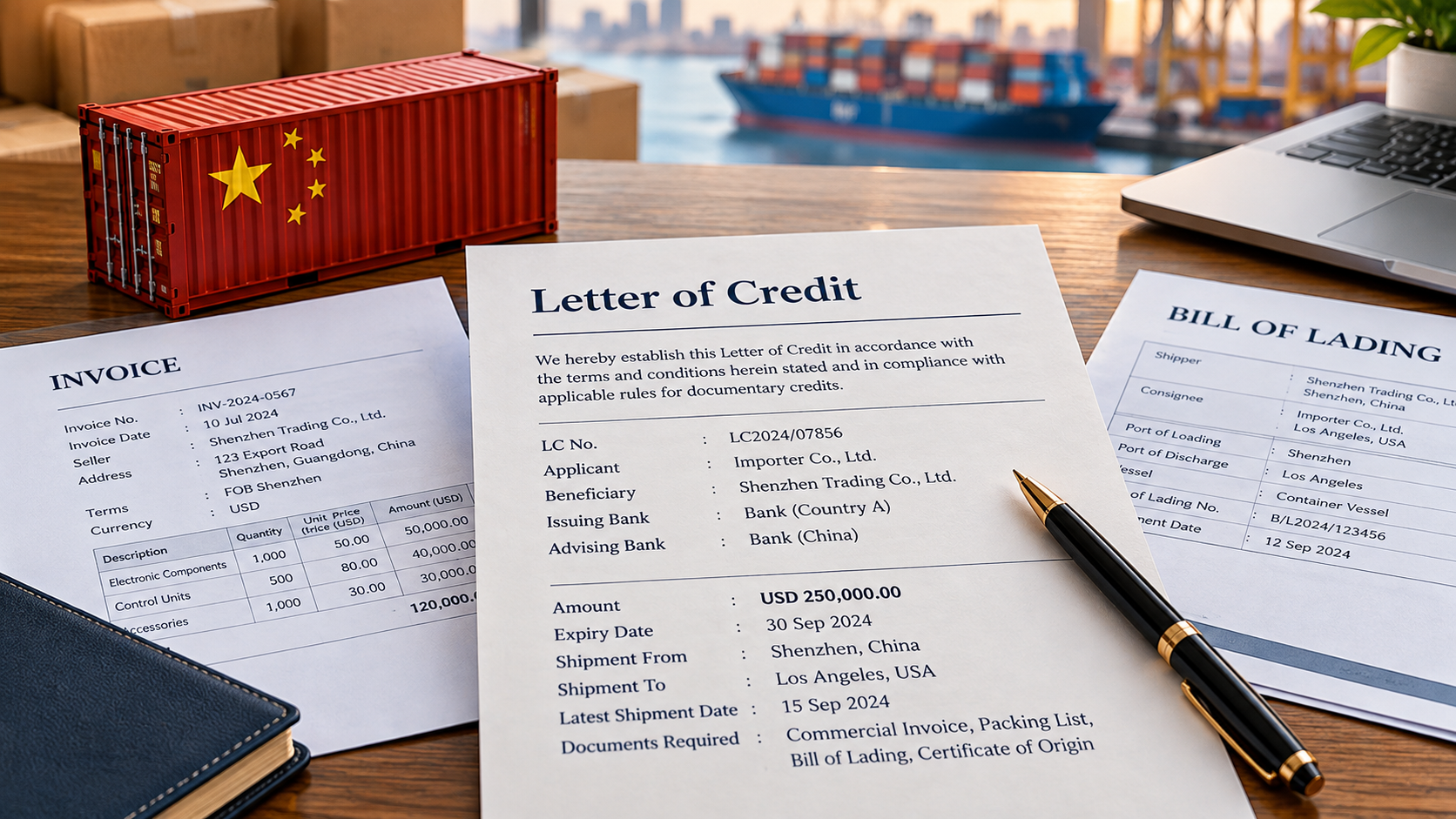
Every year, over 80% of global trade disputes involving Chinese suppliers trace back to payment terms poorly defined at contract stage. A letter of credit (LC) remains the most reliable payment instrument for importers sourcing from China, precisely because it ties disbursement to documentary compliance rather than trust. Understanding how it works, step by step, can mean the difference between a smooth shipment and a costly standoff.
What a letter of credit actually does in China trade
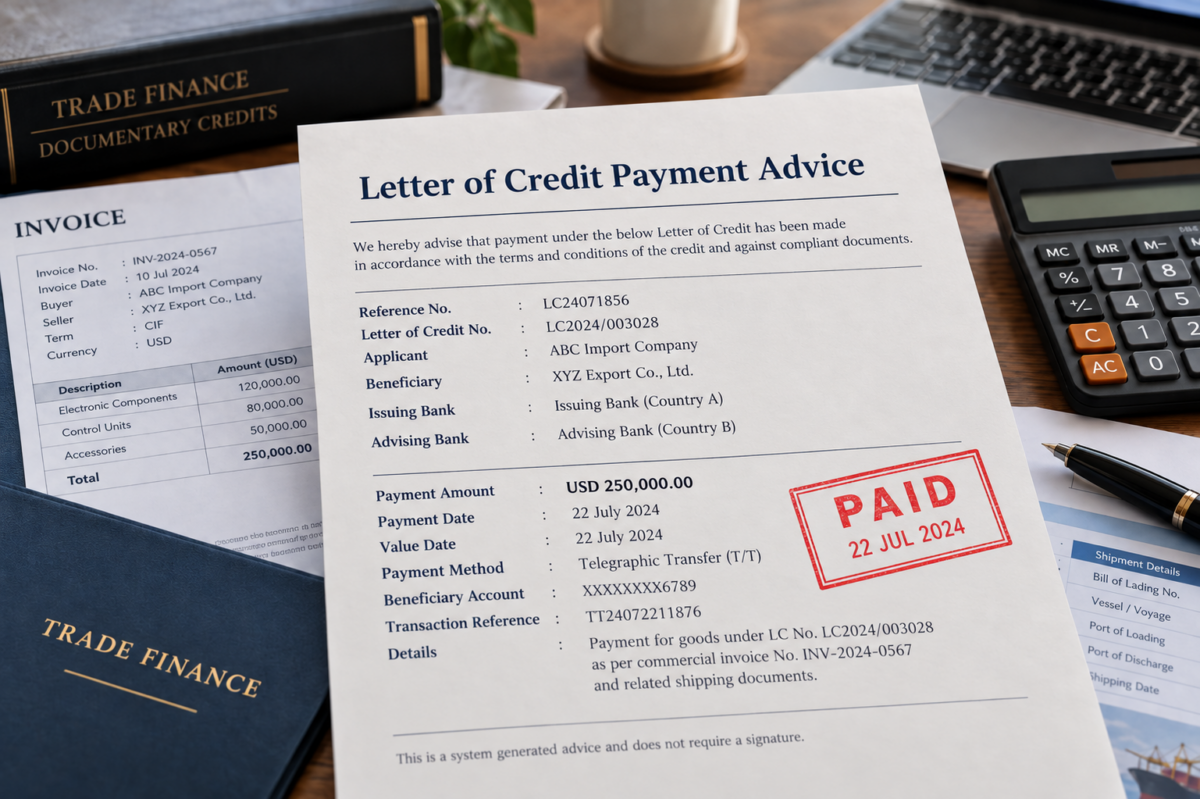
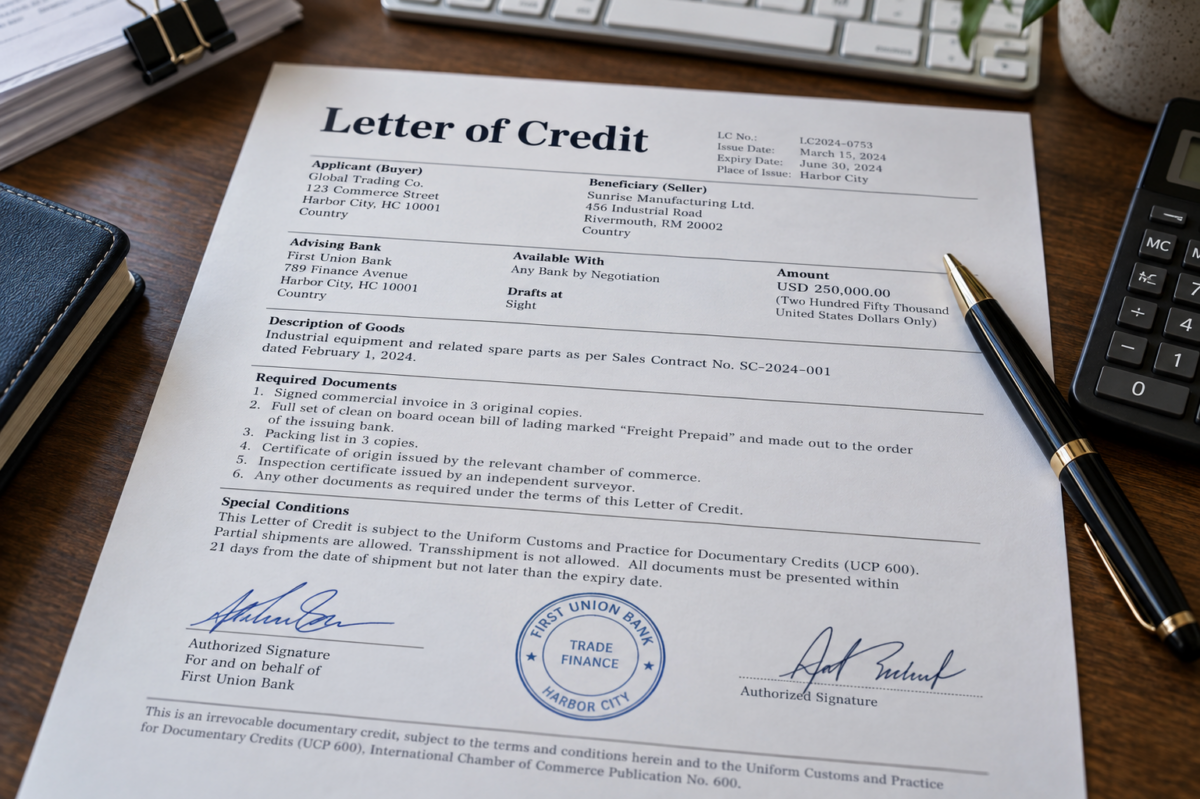
An LC is a formal commitment issued by your bank (the issuing bank) to pay your Chinese supplier (the beneficiary) a specified amount, provided the supplier presents a set of compliant documents within an agreed timeframe.
It shifts the risk from a handshake agreement to a structured banking mechanism. The supplier gets payment certainty; you get document-based proof that goods have been shipped as specified.
In practice, most LCs used for sino-western import transactions are irrevocable documentary letters of credit governed by the ICC Uniform Customs and Practice for Documentary Credits (UCP 600), in force since 2007. This means neither party can unilaterally cancel or amend the LC once it is issued and accepted by the supplier’s bank (the advising or confirming bank).
One subtlety that importers frequently overlook : a confirmed LC adds a second layer of payment guarantee, since the supplier’s local bank (often in Shanghai or Guangzhou) also commits to paying upon compliant document presentation.
This matters when your issuing bank is unknown to the Chinese supplier, which is common for first-time transactions. Keeping this distinction visible, ideally tracked in a centralized procurement dashboard, helps you negotiate more efficiently on successive orders.
Step-by-step process to open and use a documentary credit
Opening an LC for importing from China follows a clear sequence. Skipping any step typically generates discrepancies, delays, and extra banking fees that can reach 0.5% to 1.5% of the LC value per amendment.
- Negotiate payment terms with your supplier before approaching your bank. Agree on LC type (sight or usance), currency (USD is standard in China trade), amount, and expiry date.
- Submit an LC application to your bank, including the purchase contract, proforma invoice, and a detailed list of required documents.
- Your bank issues the LC and transmits it via SWIFT to the advising bank in China.
- The supplier ships the goods and gathers all required documents within the validity period.
- Documents are presented to the advising or confirming bank, which checks compliance and forwards them to your issuing bank.
- Payment is released upon document approval, either at sight or at the agreed deferred payment date.
The documents required in Chinese export transactions almost always include : a commercial invoice, a full set of original bills of lading, a packing list, a certificate of origin (often Form E for ASEAN-China FTA or Form A for GSP), and an inspection certificate if specified. Each document must match the LC terms exactly, down to the description of goods and port names.
Critical documentary requirements and common risk areas

Document discrepancies are the single biggest operational risk in LC transactions. According to the International Chamber of Commerce, roughly 70% of first presentations under an LC contain at least one discrepancy, which triggers delays and additional fees.
In China-specific trade, the most frequent issues involve inconsistent goods descriptions between the invoice and the bill of lading, late shipment beyond the LC deadline, and missing endorsements on transport documents.
| Document | Key requirement | Typical discrepancy |
| Bill of lading | Full set of 3 originals, “clean on board” | Missing “on board” notation or wrong consignee |
| Commercial invoice | Exact goods description matching LC wording | Abbreviations or different unit prices |
| Certificate of origin | Issued by authorized body (e.g., CCPIT in China) | Wrong form type or missing stamp |
| Packing list | Consistent weights and carton counts | Totals not matching invoice quantities |
Working with suppliers who have prior LC experience dramatically reduces discrepancy rates. When onboarding a new Chinese factory, requesting copies of previous LC presentations they have successfully completed gives you a concrete benchmark. Tracking this data across your supplier panel, alongside shipment timelines and quality metrics, helps you prioritize which partners are LC-ready and which still need hand-holding through the process.
Making your LC strategy work across multiple orders
A single LC transaction teaches you a lot. Scaling the approach across an entire sourcing portfolio is where real efficiency gains appear. Revolving letters of credit, for instance, automatically reinstate their value after each drawing, making them ideal when you import the same product category from the same supplier on a recurring basis, typically every 30 to 60 days.
Timing matters more than most buyers expect. Chinese New Year typically shuts down factory operations for two to four weeks, meaning any LC with a shipment deadline falling in late January or early February needs buffer built in, usually an extra 10 to 15 days minimum. Missing this creates late shipment discrepancies that are entirely avoidable with forward planning.
Finally, the cost side deserves attention. LC charges typically include an issuance fee (0.1% to 0.5% of the LC value), amendment fees (around $75 to $150 per amendment), and confirmation fees if you request a confirmed LC.
These costs are negotiable with your bank if your import volume justifies it. Centralizing visibility over all open LCs, their expiry dates, document status, and associated costs in one place prevents the silent margin erosion that hits importers managing multiple concurrent transactions without proper oversight.